

THE IDEA OF PERSONAL LEADERSHIP
Click to listen to Fiona talking about Personal Leadership.
VALUES
The concept of personal values is both complex and simple. Complex because these values are likely to have started in our family of origin and have been developed by our life experiences and core beliefs. Simple because it is easy to see how values and beliefs drive our behaviour.
The beliefs of parents and parental figures shape the early development of our values. These beliefs can be social, political, religious and moral and will be impacted by place, education and social standing. The subsequent values are likely to be how we approached the world and made judgements about good/bad, right and wrong, appropriate and not appropriate. These beliefs and values form our attitude and how we think about people, places and situations.
As we grow and develop, and are exposed to wider influences and experiences, our beliefs, values and attitudes change. As adults, we have beliefs, values and attitudes that are developed independently of those of our parents and parental figures, as well as those we choose to keep from those early influences.
People care about values. Some care a lot and will actually decide who they work for and why based on the value proposition and how an organisation measures up to its professed values.
A 2018 survey by LinkedIn found that values are the number one priority for employees. Just under two-thirds (71%) would take a pay cut to work for a company that has shared values and a mission they believe in, and 39% would leave their current job if their employer asked them to do something that conflicted with their own morals or ethics. Almost half (47%) want to work in an environment where they can be themselves and have a positive effect on society (46%).
Appreciating that North Ayrshire has its own organisational values of Focus, Passion and Inspiration, in the context of this leadership programme, it is helpful for everyone to reflect on their personal values.
We invite you to complete this simple online self-assessment and see what surfaces for you. When does each value make you feel good about yourself, and when does it get in the way? https://personalvalu.es/
When you have completed your assessment, please print your results and then upload your top 5 values to the Values Accumulator.
Before Thinking Space 2, you will be asking your team to complete this activity and upload their results.
INTRODUCING TRANSACTIONAL ANALYSIS
Transactional Analysis is a framework that can help us to be more assertive and effective in our communication, whether this is at home or at work. It makes sense in the context of the work that we are doing because it is connected to the development of values and behaviours and how these show up. As a framework, it helps us to identify helpful and unhelpful patterns and to make changes to improve communication and the relationship.
We all have communication preferences; these have been developed over time since we were small and have been impacted by parents and parental figures, our feelings and emotions, and what we have learned as we have grown and developed.
Eric Berne created a framework that helps explain these patterns, when and where they are helpful and when and where they can get in the way for us.
Understanding our preferences and those of others can help us to respond rather than to react and to be considerate about what and how we say things, especially in high-stakes situations.
Download and complete the questionnaire by pressing the tab below. Complete to page 5. Go with your gut; there are no right or wrong answers. Print your results and bring them with you to the workshop.
Think about helpful and unhelpful patterns of communication you have with people and how you could change these.
INTRODUCING STRENGTHS BASED LEADERSHIP
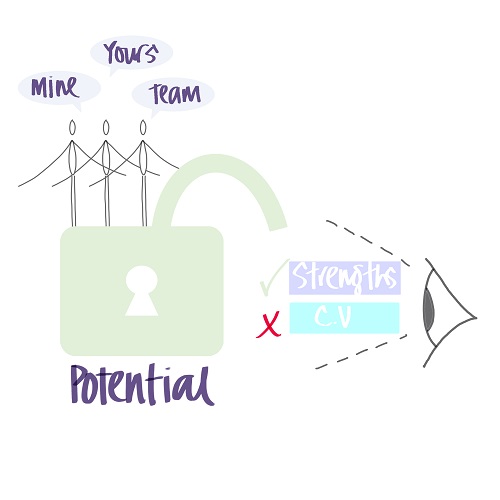
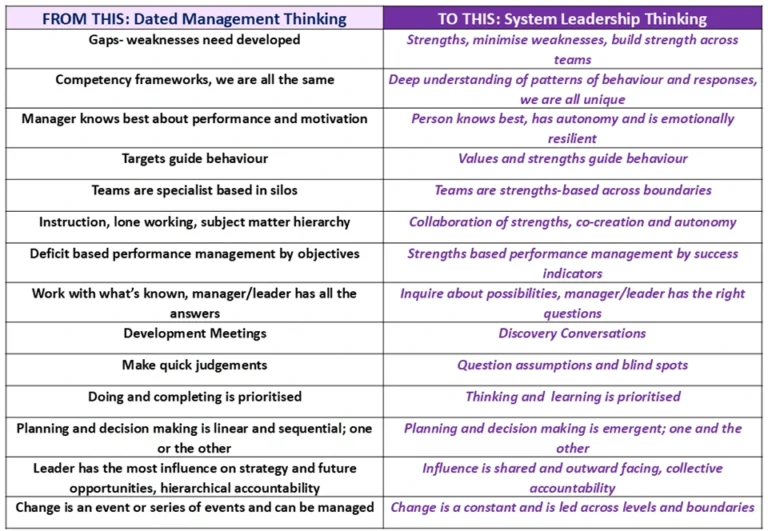
Many leaders and organisations have come to the simple but powerful realisation that to get the most out of people, you must build on their strengths. And yet, even though the strengths-based approach is now conventional wisdom, the tools and systems inside organisations such as performance appraisals, mandatory training, and succession planning systems remain stubbornly remedial and almost exclusively focused on measuring skills and knowledge, finding gaps, and attempting to plug them. The conversation is not balanced. It’s unusual to be asked, ‘how might you use your strengths to improve your customer relationships?’ and more usual to be told, ‘you need to improve how you engage with customers. I suggest XYZ training and development’.
Strengths-based leadership is rooted in positive psychology and assumes that every person has their own specific combination of signature strengths that allow them to perform at their best and that magnifying these strengths instead of repairing weaknesses helps people to be more productive and proficient. Strengths-based leaders help people to identify, utilise and develop their strengths.
Instead of ignoring weaknesses, strengths-based leaders make weaknesses less relevant by allocating tasks according to employees’ strengths and by stimulating collaboration between team members who have complementary strengths. Academic studies have shown that strengths-based leadership is associated with increased personal well-being, creativity, psychological well-being, performance, reduced burnout and absenteeism.
The strengths approach and the associated processes that we will share in this toolbox are aligned to a process called Appreciative Inquiry. In a nutshell, this process is an individual and organisational mindset based on what’s working. It does not avoid challenging conversations, but shifts the starting point to thinking about how strengths can be used to ’fix’ things rather than the deficit-based problem-solving approach.
THE JOURNEY TO A STRENGTHS BASED APPROACH
TAKING THE STRENGTHS ASSESSMENT
Each leader will access a code to complete an online Strengths Assessment called the Clifton Strengths Finder. Those on the first programme accessed this via a textbook; those of you on the second programme will also access the assessment via a different book called ‘How Full is Your Bucket’.
Either way, the assessment will provide you with a report of your top 5 strengths.
The short video below gives a snapshot of how the Clifton Strengths Finder was developed.
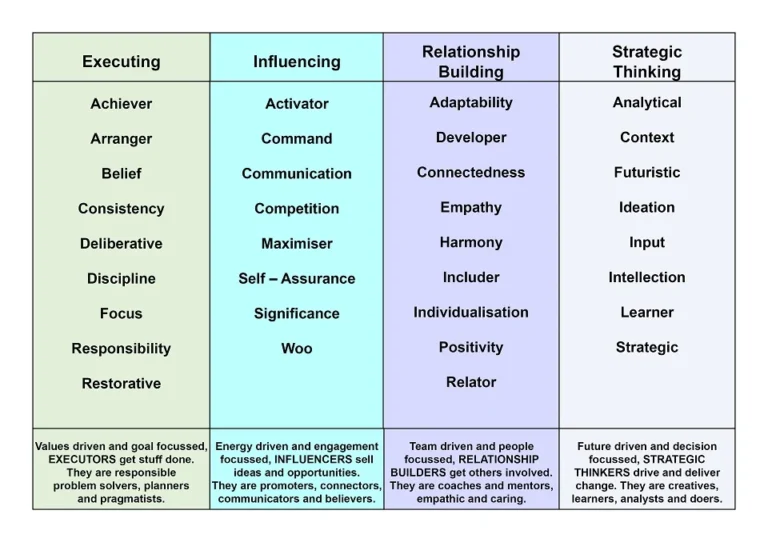
These may fall across the 4 domains shown below, only be in one domain or be across one or two – the assessment is unique to you ,and there are no right or wrong answers.
- Executing: People with strengths in this key domain know how to rally around a goal and get things done. Differing strengths might dictate the style of getting to the goal, but people who have strengths in this area make a massive contribution to things happening.
- Influencing: People with strengths in this key domain know how to share and embed the team’s ideas both inside and outside the organisation. These people are natural persuaders, inspire others to adopt their ideas and are vital to moving teams forward in communities.
- Relationship Building: Those with strengths in this domain tend to keep groups together. They’re the social glue: the mortar between the foundation building blocks. They know how to create and maintain groups such that the whole is much greater than its parts.
- Strategic Thinking: People with strengths in this domain tend to force the group to look at the big picture and toward the future – what might be. Always reviewing the data and applying what they learn, strategic thinkers move the organisation forward – stretching its members to think beyond what is, to the possibilities of the future.
PRACTICAL TOOLS
Below you will find a helpful handout to read and use alongside your reports you received from Gallop.
LEGACY and PURPOSE
PERSONAL LEGACY
We often think of legacy as something we leave ‘behind’ after we are gone from the team, the organisation or when we die. This view somewhat relies on others deciding what our legacy is and makes us more passive in the process.
One of the habits that Stephen Covey wrote about in his iconic book Seven Habits of Highly Effective People was Begin with the end in mind. These were his ideas around building purpose and personal legacy.
He suggested three steps:
- Write a personal mission statement: Define your core values, your long-term purpose, and the kind of person you want to become.
- Do the eulogy exercise: Imagine attending your own funeral and ask yourself what you hope your family, friends, and coworkers would say about your character and contributions.
- Plan micro and macro goals: Apply the habit to big life choices or small daily tasks, such as knowing the exact outcome you want from a meeting before you walk into the room.
We will be exploring this more at the workshop.
LEADERSHIP LEGACY
Another book that provided inspiration around legacy was the work of James Kouze and Barry Posner. In their book A Leaders Legacy, they outlined four behaviours that, when applied with consistency, contributed to the journey of creating a legacy.
ASPIRATIONS – All serious leadership starts from within.
RELATIONSHIPS – Leadership is a relationship between those who lead and those who follow leadership is personal.
SIGNIFICANCE – The leaders who have the most influence on us are those who are closest to us.
COURAGE – Leadership is courage in action.
We will be exploring these concepts more at the workshop.