

STRENGTHS BASED COACHING
Strengths-based coaching is a personal and professional development method that focuses on what people naturally do best rather than trying to fix their weaknesses.
Core Principles
- Focus on what is right: Instead of asking “What is wrong and how do you fix it?”, this approach asks, “What is working and how can you use it more?”
- Innate talents: Many behaviours and natural aptitudes are biological or deeply ingrained, rather than purely learned skills.
- Energy and engagement: Working within areas of strength boosts intrinsic motivation, focus, and performance.
How the Process Works
- Discovery and Assessment: The Clifton Strengths finder has enabled you and your team to identify your signature strengths.
- Naming and Claiming: Coaching helps team members to observe, name, and gain conscious awareness of specific strengths they take for granted, aligned to what the organisation needs from them.
- Application: Individuals learn to apply their top strengths to new tasks, team challenges, and everyday problem-solving.
- Managing Weaknesses: Weaknesses are not ignored, but they are managed through the use of strategies, delegation, or pairing with complementary strengths.
THE WHAT’S WORKING GRID (WWG)
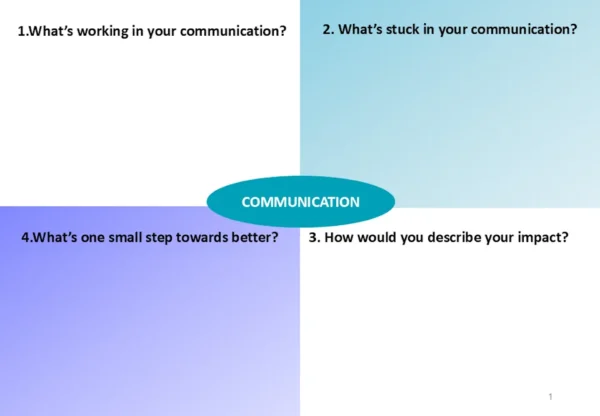
The WWG is a practical tool based on the Appreciative Inquiry theory about building on what’s working to navigate next steps. A variety of WWGs are available as pptx slides, and we have provided an ‘empty’ grid for you to use for topics that matter to you and your team/stakeholders etc.
TIME
Ensure that the conversations are planned in advance. I would be tempted to start with people where you have a good relationship and remember to explain why you are having conversations in a different kind of way.
THE PROCESS
- This works well on a 1-1 basis and in groups, the latter coupled with the 1,2,4 framework.
- Use one of the provided WWG files or decide what you want to explore and put that topic/project/behaviour in the centre of the WWG.
- Give the person or people the WWG at least 1 week in advance of the conversation.
- If it’s a 1-1, 30-60 minutes depending on the topic. Where you are also completing the WWG as well as the person prior to the conversation (Strengths/Performance/Feedback, you will need a bit longer.
- If it’s a group (3-12), then a minimum of 60 minutes.
- If it is a generic WWG about a project, change or collective strengths, then you can put people into pairs to complete a composite grid and then put 2 pairs together to produce a final composite.
- This really crystallises thinking, and you can take the final grids away and summarise those and next steps.
- Around 20 minutes to complete for self (or in advance), 15 minutes in a pair, and 20 minutes in a group of four.
- The key, as with all these conversation starters, is that they need to be real things that are being spoken about, and you need to follow up with next steps within 5 working days.
Downloads
INTRODUCING THE POWERFUL QUESTIONS CARDS

Each leader was given a pack of Powerful Question cards. These cards uncover thinking and feeling that may not have been obvious to you or to others. The idea is to build trust and connection away from task and target, connecting to people as people.
TIME: 30 minutes (1-1 or 60 minutes in a small group) – including setting up and getting feedback.
Ensure that the conversations are planned in advance; you could ask for volunteers from the team, however if you do it this way, it is important to try it with a mix of people and not just the usual suspects that volunteer for everything. I also think it’s a great process with a small team so no more than 10, or in small groups of 4, which might feel safer. Ideally, you have a call explaining it. On no account should this just be an email.
It does work online, but I recommend trying it first face-to-face with people.
PROCESS FOR BOTH 1-1 AND GROUP
- Everything in the earlier sections around creating Thinking Space (page 5) applies here.
- 5 minutes to set the scene, thanking them for taking the time.
- Ideally, you try both ways: 1-1 and a small group with different people.
1-1 CONVERSATIONS
- Cards are spread out on the table face up, questions not showing.
- Ask the person to pick any card and ask you the question. Answer as fully and openly as you can.
- Next, reverse the process. You can always ask them the additional ‘what more would you like to think or feel or want to say’.
- Swap again; this time; ask them to ask you the “what more” question after your initial responses.
- Swap again; this time, give the person the opportunity to choose a card by looking at the questions. Respond to the question as fully and openly as possible.
- Repeat with you asking them a card you have chosen.
- Ask the person how they felt about the process and where it could be used in the wider team.
- Finally, offer them some appreciation for getting involved and let them know you will provide feedback on the results.
SMALL GROUP
- Cards are spread out on the table face up, questions not showing.
- Ask the first person to pick any card, read out the question and respond to the question as fully and openly as they can.
- If the question is too personal, they can put it back and choose another (not over and over, though).
- After each person, you can come in with the ‘what more’ question. The easiest way to do this is to add it to the question, for example, “…so, Fiona, what more would you like to say about?”
- The next person does the same and so on until everyone, including you, has responded to one question.
- Depending on time and numbers, you could divide them into two smaller groups, and they have another round.
- Ask the group how they felt about the process and where it could be used in the wider team.
- Finally, offer them some appreciation for getting involved and let them know you will provide feedback on the results.